SAA’s Response: More Than a Vote – What Saskatoon’s Public Art Debate Taught Us
Written by SAA Executive Director, Em Ironstar
August 12, 2026
Last Updated: 5:00pm, August 14, 2026
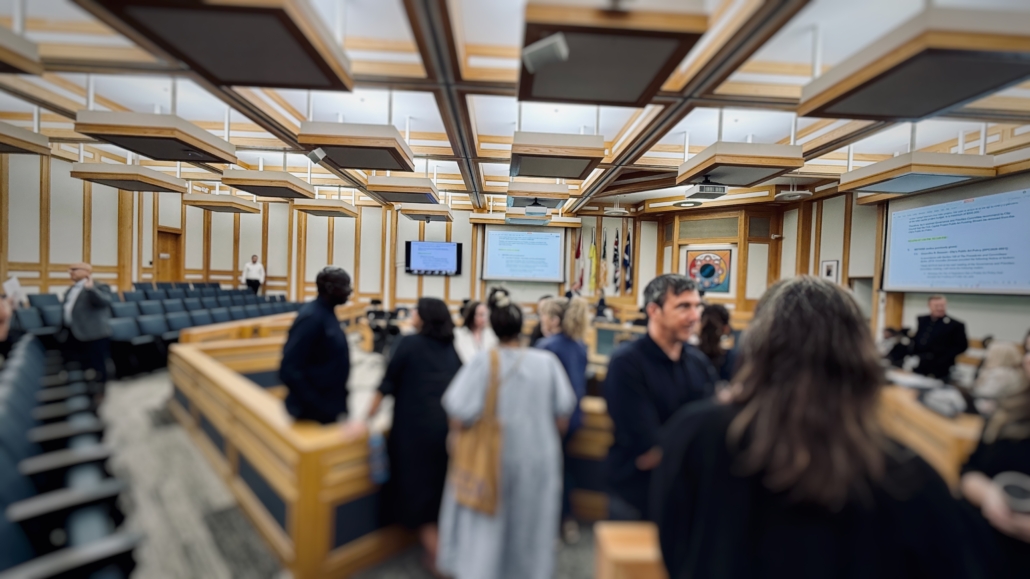
On August 12, Saskatoon’s Governance and Priorities Committee voted 8-3 against recommending the removal of the Civic Capital Project Public Art Funding Stream from the City’s Public Art Policy.
The outcome matters. It preserves a funding mechanism that has helped bring public art into major civic projects for more than a decade, and it came after close to 40 written submissions came in ahead of the meeting, the overwhelming majority in support of keeping the funding stream in place. Dozens of Saskatoon residents spoke or sent letters directly. Our public campaign generated over 340 messages to councillors in the days leading up to the vote.
After spending the day at City Hall listening to the presentations, questions, and the exchanges among Council, one thing became clear: the most important outcome wasn’t the vote itself. It was the conversation that led to it.
For much of the past two weeks, the public discussion centred on Modern Erratics. As often happens with public art, a complex project was gradually reduced to a simple headline.
We heard a line from artist, researcher, and Director of USask Art Galleries and Collection, jake moore, during the meeting that captured something real about how this story got told: reducing Modern Erratics to “three plastic rocks” is a little like calling an elaborate cathedral “a brick building.” Something got lost in translation between what the project actually was and how it was covered, and several councillors said the same thing in their own words: this was, at its core, a communications failure, not a funding failure.
Councillor Donauer made a point in his closing remarks worth repeating, because it’s accurate and it matters: most of Saskatoon’s best-loved public art, the Muskox, Gabriel Dumont, John Lake and Chief Whitecap, Prairie Wind, and many others, was never funded through this stream and was never at risk in this vote. What was actually at stake was quieter and further off: whether Saskatoon keeps requiring public art consideration on major future civic projects, the libraries, recreation centres, and public spaces still to come.
By the end of the meeting, the debate had shifted away from whether people liked one particular artwork and toward a broader question: how should public policy respond when one project becomes controversial? The answer offered by most speakers, and ultimately by most of Committee, was not to eliminate the policy, but to improve it.
If there was one word repeated throughout the day, it was communication.
Again and again, presenters and councillors acknowledged that the rollout of Modern Erratics left too much unexplained. Opportunities were missed to tell the story of the project, introduce the artists, explain the selection process, and use the videos and educational materials that had already been created.
One presenter observed that it’s difficult to support what we don’t understand. That simple line became one of the day’s clearest takeaways. The discussion wasn’t ultimately about whether public art has value. It became about how we communicate that value, and how we invite people into the conversation before projects become headlines.
Public art isn’t separate from the cultural life of a city. It’s one part of a much larger ecosystem that includes artists, arts organizations, festivals, museums, galleries, theatres, libraries, recreation centres, and public spaces. The Civic Capital Project stream under debate this week is one part of that picture, not the whole of it. As Councillor Parker put it during the debate, this was never a question of choosing between funding one area of arts and culture or another. It’s not one or the other. It works collectively.
One correction worth making directly: a comparison was drawn during the debate between this policy and the City’s support for Remai Modern. Remai Modern is excellent, and the City’s investment in it matters, but it isn’t a substitute for this mechanism. The Public Art Policy itself states plainly that it does not apply to Remai Modern. They serve very different purposes.
It’s also worth noting that the City’s Public Art Reserve, one of the policy’s other funding streams, has had its annual contribution cut in half over the past year, from $20,000 to $10,000. That has nothing to do with this motion, but it’s a reminder that the more urgent issue isn’t any single mechanism, it’s whether public art funding across the board is being adequately resourced.
Several presenters broadened the conversation even further: public art’s role in creating welcoming public spaces, in reducing vandalism through thoughtful design, and in helping young artists imagine a future for themselves in Saskatchewan. City administration noted that installing mural wraps at transit sites experiencing regular vandalism reduced incidents from weekly to a few times a year, a real cost saving alongside the cultural value. We also heard a powerful reminder that public space is never neutral. What a city chooses to build into its shared spaces says something about who belongs there and what kinds of stories are worth telling.
Taken together, those perspectives point to something larger than a single funding mechanism. They point toward city-building. Cities don’t simply build roads, sidewalks, recreation centres, and libraries. They build communities.
Perhaps the most encouraging part of the discussion was that it rarely settled into a simple for-or-against debate. Even councillors who expressed real concerns about the current policy generally pointed toward review, refinement, and stronger communication rather than defending the status quo as it stands. That’s healthy. Public policy should evolve, respond to experience, and adapt as communities change.
Council has now formally directed Administration to act on several fronts, with a report-back deadline of no later than the second quarter of 2027. That includes a full review of Policy C10-025 itself, which hasn’t been substantively updated in over a decade, done in consultation with the arts community and Saskatoon residents, and covering everything from public engagement and transparency to financial limits and how “local artist engagement” should be defined and supported going forward.
Administration has also been asked to look at how other Canadian cities fund public art, to find ways future commissions are built into their sites rather than added afterward, and to make sure every future project funded through this stream includes a communications plan from the start, not as an afterthought. The Saskatchewan Arts Alliance welcomes all of this, and we’ll be watching for that Q2 2027 report. You can read the full council resolution here.
We want to thank everyone who participated in this conversation.
To the artists who shared their work and expertise. To the educators, researchers, and students who reminded us why public art matters. To the business owners, community leaders, and residents who took the time to write, speak, and ask difficult questions. And to City Council, for taking the time to listen and learn.
People will continue to have different opinions about individual works of public art. That’s inevitable, and in many ways it’s healthy. What mattered this week was something else. When presented with a difficult question, Council chose to improve rather than eliminate, to review rather than react, and to continue a conversation instead of ending one.
That’s a worthwhile outcome, and one that will shape Saskatoon’s public spaces long after the headlines about Modern Erratics have faded.

