How the Arts Make Us Human: Part One
Creating Heals Minds and Connects Hearts
By Nikki Little
This article is the first in a three-part series examining why art is important to our humanity. Throughout these articles, I’ll be referencing the stories of many members of my creative community. I owe these people a huge thanks.
This article deals with themes of grief, loss, and mental health struggles. However, it tells a very hopeful tale.
* * *
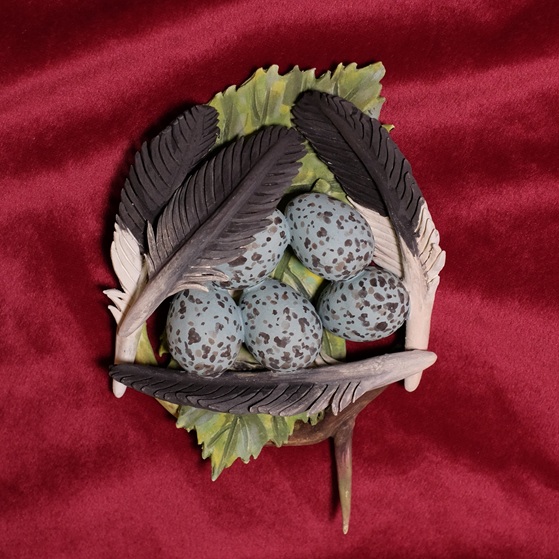
I’ve recently been finishing an artwork I started several years ago. It’s a delicate nest of loggerhead shrike feathers, encircled in a hawthorn branch, and cradling five tiny, speckled eggs. Returning to this piece feels like having a conversation with a past version of myself, and I’m left with some perspective on how art supports my own wellbeing.
When I created these feather sculptures, I was overwhelmed with grief for my sister’s death. She passed away in her twenties. During the first wave of shock, I couldn’t create at all. After about a year had passed, I began sculpting intricately carved feathers. I often brought actual feathers into the studio to study, and I remember watching how the faintest breath would make the downy barbs flutter and dance. In my sculptures, I painstakingly tried to capture that airy movement. My sister’s life felt as delicate and ethereal as those feathers. Carving them was an act of meditation, an act of love, and an act of grieving.
Many of us use art to support our mental wellbeing. I hear this all the time in the recreational art classes I teach. At the start of each session, I ask everyone to share why they are in my class, and mental health support is a common theme.
I was curious how far this connection between mental health and art went in my community, so I ran a survey to learn more about what drives people’s creation. I specifically surveyed adults in the Regina area who have created art of any kind (music, dance, performance, visual art, written works, and so on) in the last couple of years. While my survey size was small, the results still emphasized a connection between mental health and art practices. Eighteen out of twenty-four respondents chose supporting their mental health as one of their top three reasons for creating art.
Several of the survey-takers offered to speak with me further. One of those people was Brit Sippola, a visual artist, dancer, and born storyteller. She shared how art supported her wellbeing during a challenging time.
Brit’s story began with one of her close friends dealing with a mental health crisis. When she visited this friend, the seriousness of his condition deeply shocked her. She had experienced her own struggles with mental health, but never to this degree. Helplessness overwhelmed her. So, she penned a short story to keep herself afloat.
“I kind of wrote about the bad things, like the worst-case scenarios and my deepest fears about the situation. And I found it to be really healing,” explained Brit. As an aside, her friend is now doing much better.
Mine and Brit’s stories show how art can help us self-regulate and find resilience in tough times. Another artist that I spoke to summed this up beautifully. Yasmin Dar has a many-faceted art practice, including graphic design, illustration, and photography. “For myself,” Yasmin explained, “art is the place I can always go to ground myself and it’s the one space that I can always go to that’s mine. That I shape, where I have full autonomy. I can process my feelings in that space. I can work out problems, I can find my voice, I can rejoice or grieve in that space. I can tear it down and start from scratch.”
As Yasmin alludes to, processing one’s emotions and experiences through art isn’t always pleasant or easy. It can be layered with the fears of other’s judgement. Or the emotions may just be too raw to face (like in those first few months after my sister’s passing.) But often, sometimes with the help of time, creating can be a healthy way forward.
Making art, however, is only half the story. Art is a communicative practice, and something wonderful happens in that back-and-forth. In fact, everyone I spoke to noticed mental health benefits from connecting to others’ art, not just from creating their own.
This brings me to a story Yasmin shared. When her close friend/partner for sixteen years passed away, Yasmin felt very lost and alone in her grief. On top of that, Yasmin’s young daughter was struggling to understand her mother’s grief and the concept of death.
A visual storytelling class taught by Chrystene Ells was a significant turning point for Yasmin. For this class, she chose to create an illustrated children’s book that talked about grief and death. Not only did this provide opportunities for meaningful discussions on these topics with her classmates, but it gave her an accessible way to broach the subject with her daughter.
I experienced something similar with my nest sculpture. While I was working on it in a shared studio space, another artist asked me about the work’s meaning. He asked gently prodding questions, trying to get past the superficial prettiness of the piece. I explained how it was about life, death, the cycles we go through, and our family ties. I told him about the loss of my sister, and how her life seemed delicate as a tiny feather. And I felt very seen as we spoke.
Even in moments when we aren’t processing emotions, art can help us build a healthy community. Many of my interviewees likened art to sports: they are both shared interests that create bonds between people. “Art is the glue that holds community together,” explained author RaeAnne, another creator who spoke with me.
RaeAnne explained how writing allows her to share her experiences living with a disability. However, she also spoke passionately about the expressions of others, and how their art practices make space for her. While she isn’t a musician herself, she finds great happiness attending music performances and festivals.
Having a strong community is connected to having a longer life and better health outcomes. For example, a 2012 study looked at the relationship between loneliness and poor health. It followed 1604 seniors over a span of six years. People who reported as lonely saw greater health declines over those six years than those who weren’t lonely. The lonely folks needed more support with daily tasks, struggled more with using their arms, struggled more with climbing stairs, had a greater decrease in the distance they could walk or jog, and even had an increased likelihood of death.[1]
To summarize, art can heal our minds and connect our hearts. I suspect it’s the layering of shared interests and meaningful communication that makes art like the super glue of human connection. In fact, connecting with so many other artists who graciously shared their stories has been very personally healing.
[1] Carla M. Perissinotto et al., “Loneliness in Older Persons: A Predictor of Functional Decline and Death,” Archives of Internal Medicine 172, no. 14 (2012): 1078–84, https://doi.org/10.1001/archinternmed.2012.1993.

