How the Arts Make Us Human: Part Three
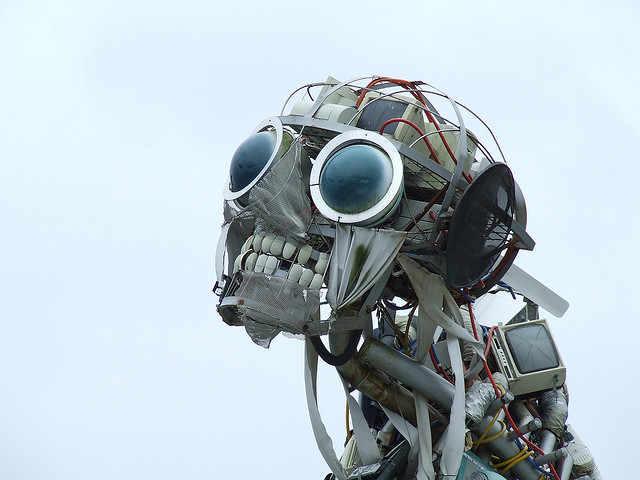 Copyleft: This work of art is free; you can redistribute it and/or modify it according to terms of the Free Art License.
 Human Creative Practice in the AI Era
By Nikki Little. This article is the third in a three-part series examining why art is important to our humanity. Throughout these articles, I’ll be referencing the stories of many members of my creative community. I owe these people a huge thanks.
* * *
This final article may feel like an abrupt left turn. Up until now, I’ve been talking about the benefits of art to humanity. These benefits include improving mental health, creating communities, and shaping cultures. What does that have to do with generative artificial intelligence, or AI?
When I say artificial intelligence, I’m referring to computer programs that are trained on massive amounts of data. They are designed to give outputs based on feedback from previous results. When I say “generative” AI, I’m referring to AI programs that create finished works seemingly from scratch such as writing, images, videos, or music.
The reason I’m bringing up AI is that we’re starting to see creative tasks being given to such programs instead of to actual artists. For example, since 2024, Regina’s Frost Festival has featured an AI Poetry Hut.[1] Visitors are asked to share three words on what home means to them, and the Poetry Hut outputs a haiku. I can’t be certain that this use of AI specifically replaced a job that would have been offered to a human poet at the festival. However, I would have preferred to interact with someone who could teach me to connect with the meaning of those three chosen words.
(As an aside, I attempted to try the Poetry Hut at the 2026 Frost Festival. Maybe I would be surprised by the feelings its poems evoked? But the activity was not running, likely due to the extreme cold that day. In this case, maybe a human would have been the more reliable choice.)
There are, of course, broader conversations to have about the morality of AI. We could discuss its environmental impact, copyright and ownership of the materials it trains on, and whether AI is being trained on itself in a feedback loop of falsehoods. But what I want to focus on here is that I think artmaking is inherently human work, and not something we should give up to artificial intelligence.
* * *
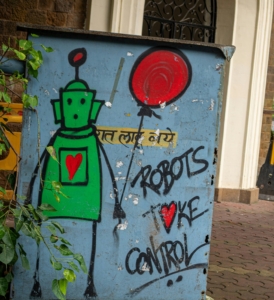 “I bought a weird otter print in the Yukon this summer,” Roxanne says, “Because I like otters, but it also reminded me of my elongated wiener dog. Because it was like . . . stretched out.”
Roxanne is a graphic designer, ceramicist, photographer, and dabbler in many other creative mediums. And this anecdote hits the nail on the head about why art created by humans is important. “People connect with things that other humans have made, and I think that’s the biggest difference between [human-made] art and AI,” Roxanne explains.
For several years now, Roxanne has taught graphic design. In her tech-forward field, she is expected to show students how to incorporate AI into their workflow. She understands that the best way to use AI is as one part of a process that still hinges on human input. Yet she’s seen shifts in her industry towards letting AI create design work from start to finish.
“It all comes down to money and what clients are willing to pay,” she admits. If just sharing a prompt and hitting a button creates a passable result, many people will choose this fast, affordable option. Yet I wonder, are such generated design materials worthwhile, even with their reduced costs?
AI-generated advertisements often leave me feeling hollow and somewhat disoriented. It’s not like I truly enjoyed ads before AI, but I at least felt like someone was trying to make me care about something. While AI advertisements may capture my attention for longer (usually while I try to process if what I’m seeing is real), they’re not really encouraging me to purchase the products being advertised. In fact, I’ve started actively avoiding anything advertised with AI.
It may strike some folks as odd that I’m speaking about advertising in connection with art. However, many folks gravitate towards commercial art practices to make a steady living while still stretching their creative muscles. That is the case for Roxanne, who discovered she loved the challenge of designing visual layouts while working on her high school’s yearbook. The realization that she could make a living using her creativity inspired her to study graphic design.
Roxanne agrees that “It’s doing a disservice” to the commercial arts to make entirely AI generated advertisements. “Ads are supposed to be trying to make a human connection, so people care about them and act off of them.” If even commercial arts need to make meaningful connections to their audiences, can AI truly take the place of human artists?
However, let’s step away from using creativity to make a living. Even people who create art recreationally may be tempted to use AI generation to make something aesthetically pleasing. What are these people missing out on?
* * *
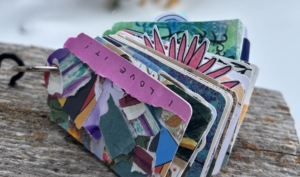 Leanne Tremblay’s artmaking is entirely for fun and not connected to her job. And while her creative process is connected to technology, it’s also centered on those human connections. She participates in a global online artmaking event called #The100DayProject.[2] The goal is to create something for 100 days in a row. (Although many people give themselves the grace to finish the project at their own pace.) Everyone shares their creations online and gives each other feedback and support. The project is mostly hosted on Instagram and through an official website.
“People are making things [no one] would never buy, but it’s just so fun!” Leanne explains. For her last two rounds of #The100DayProject, she made collaged tags (like gift tags or luggage tags). Her projects are inspired by junk journaling artists she follows, just in a more compact form. “You’re super pumped when people are commenting, being like, ‘oh my god, I’m making collage tags too!’ They’re all pumped about your creations, so you go look at their creations . . . and you support them.”
In fact, the online connections Leanne made have extended into her real life. One of the people she connected with through Instagram has become a real-world friend. They bonded over both speaking French, and they met up in France last year. Closer to home, Leanne invited family and friends to make “guest tags” for her projects, encouraging bonding over the act of creation. She noticed that many of these friends and family wanted to make more things together afterwards. “They right away recognized why doing it was important and what benefits it had,” explains Leanne.
* * *
I feel like Roxanne and Leanne pinpointed two undefinable things that generative AI creations are missing. What makes art art is the life experiences we filter it through and the connections it helps us make with others.
Even when our creations heavily copy the works of others, we are processing and reinventing something thorough the lenses of our own lives. AI doesn’t have experiences. It doesn’t have pet wiener dogs that an artwork can remind it of. It doesn’t feel inspired by other artists who junk journal. AI doesn’t need the mental health benefits of self-expression because it doesn’t have mental health.
Furthermore, AI doesn’t make connections with others. It doesn’t have friends and family to share its creations with. It doesn’t bond with others over time spent making together. And it definitely isn’t interested in conversations that can be started by its creations, or how that can shift others’ viewpoints.
All AI can do is meet certain aesthetic parameters. That isn’t enough, and we can feel it when we observe AI creations. This is why we will never truly be able to replace our artists and our creative jobs with generative AI. Art is human work.
[1] “Poetry Hut,” Lucion, https://lucion.ca/blog/portfolio/poetry-hut-copy/.
[2] Lindsay Jean Thomson, #The100DayProject, https://www.the100dayproject.org/.
